education
Series: Rites of Passage – Haiti’s Wilson Bigaud
Portrait of the Haitian master Wilson Bigaud (1931-2010), a student of Hector Hyppolite and a figure of the Haitian art renaissance, known for his scenes of everyday life and rites of passage.

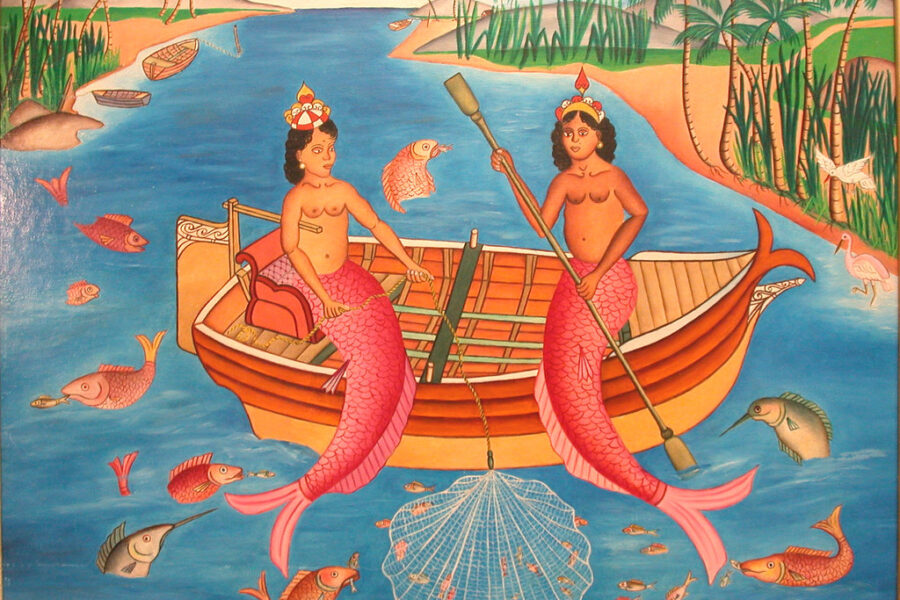
The Haitian master Wilson Bigaud is renowned for his works depicting everyday life and rites of passage – Vodou rituals, fortune tellers, weddings, cockfights and carnivals – with voluminous figures and lucid colors.
Born in Port-au-Prince, Bigaud was one of the first to attend DeWitt Peters’s Centre d’Art in Haiti in 1946, where he studied with Hector Hyppolite, known as the “Grand Master of Haitian Art.” His talent quickly became known locally and internationally. Bigaud’s signature work, Paradis terrestre (1952), which depicts an Eden-like scene in lush colors, won second place at the Carnegie International when the artist was 21 years old.
Another painting, Murder in the Jungle (1950), was acquired by the Museum of Modern Art and was featured in a 1967 survey of mid-century Latin American and Caribbean art. Bigaud also produced murals commissioned for the famed Holy Trinity Cathedral in Port-au-Prince. Mental illness brought his career to a halt in 1957 and, although he took up painting again in the 1960s, Bigaud’s later works did not enjoy the same success as his early paintings.
WILSON BIGAUD (Haitian, 1931-2010)
Wilson Bigaud was an integral part of the Haitian art renaissance. He is hailed as an innovator of the truly naïve genre, with his paintings of rural people with wide, pop eyes and figures with disproportionate bodies. The renowned artist Hector Hyppolite took Bigaud on as an apprentice when he was only fifteen. Bigaud joined the Centre d’Art in Port-au-Prince in 1946 and soon afterward painted his masterpiece, Miracle à Cana (1950-1951), for the Holy Trinity Cathedral.


Follow Wilson’s work online > Artsy