
 education
Algorythme
Caribeart Data
Algorythme — The Ecosystem of Caribbean Artists
Each strand of seaweed is an artist, each cluster a territory. The longer an artist has been practising, the higher their seaweed reaches toward the light. Hover over a strand, or click a flag to light up an entire territory.
Visual artists only; the survey is not exhaustive. See the methodology
You have discovered 20 artists. Create a free account to explore all Algorythme artists and open their pages.
Create a free account →Demo data: the real database is being compiled. The “Demo artist” names are fictitious.
The current
The seaweed sways continuously, from base to tip, as if carried by the water.
On hover
The seaweed lights up and shows the artist, their territory and medium. A click opens their page.
Clicking a flag
All the territory's seaweed lights up and bubbles rise, with a little bubbling sound. A second click turns it off.
Browse by territory
Caribeart in numbers
Without data, Caribbean art leaves no trace.
Who is exhibiting, where, and since when? In the Caribbean, this information is scattered across dozens of territories, languages and venues, when it is recorded at all. Bringing it together makes artistic trajectories traceable: proving that a work has been shown, following an artist from one island to another, telling the story of Caribbean art with facts.
Caribeart has been doing this work since 2018. Here is where we stand.
* Site internet, Facebook et Instagram, 2018–2026. Source : Agorapulse.
Why this research
2017–today:
nine years of documenting Caribbean creation.
The starting point
In 2017, typing “Saint Lucian artist” into Google returned barely five results.
There was almost nothing online. Today the landscape has changed, thanks to this work and to that of many other players and initiatives across the region.
Algorythme grew out of this observation: the artists existed, and so did their works, but their digital traces remained fragmentary. In 2017, the online presence of Caribbean art was still poorly structured. Since then, many initiatives have helped change the landscape. Even so, realities remain uneven across territories and depending on the means of cultural players: some museums still have no website or regularly updated Google listing, documentary resources remain unequally accessible, and data on artists and their works is still scattered. The ability to document, share and reference artistic practices also depends on the digital resources and skills available. And whatever is poorly documented online is harder to find in search engines. Those five results are where it all began.
Mapping then becomes essential: making data accessible also means creating the conditions for greater visibility. Since then, we have travelled to some fifteen territories, reached out to artists and venues, become part of local ecosystems and developed monitoring methods to get as close as possible to the diversity of what we call Caribbean art.
We speak of Haitian art, Jamaican art, Cuban art. These designations are essential: they tell singular stories, identities and contexts. But they can also fit within a broader regional reading. Thinking of Caribbean art as a whole does not mean erasing the particularities of each territory, but making visible the circulations, resonances and links that run through them. Much like the notion of African art, this collective perspective can help strengthen the recognition of Caribbean creation internationally.
Caribeart believes in the relevance of this shared space: a plural artistic Caribbean, whose richness deserves to be documented, connected and made visible. This is the very essence of the platform.
Methodology
What Algorythme includes,
and what it does not.
Algorythme lists visual artists from the Caribbean or its diaspora. This survey is not exhaustive: it is ongoing research, continuously enriched.
Included
- Visual artists: painting, sculpture, photography, drawing, installation, performance.
- Artists working with technology: digital art, generative art, new media.
- Transdisciplinary practices, when their primary anchor is in the visual arts.
- A few filmmakers, at the margins: cinema is not the core of this research.
Not included
- Performing arts: theatre, music, dance.
- Professionals who support artists: curators, cultural entrepreneurs, programmers, gallery owners.
These players matter in the ecosystem, but Algorythme follows artists’ trajectories.
How to read the data
- Territory: the artist’s territory of origin, not their place of residence.
- Modern art, contemporary art: [classification criterion to be specified].
- Height of a strand: seniority, meaning the number of documented years of practice. Seniority is not recognition: height says nothing about an artist’s value or renown, and it remains indicative since the survey is not exhaustive.
Sources and verification
Profiles completed by artists and cultural venues, Caribeart monitoring (websites, press, social media), and event listing archives since 2018.
Each entry is verified before publication. The source and the date of the last update appear on every profile.
Limitations
Coverage varies from one territory to another. An artist’s absence says nothing about their importance: it only means their profile has yet to be created.
Citing this research
Research and editing: Kimberley Demagny, founder of Caribeart.
Caribeart, Algorythme — L’écosystème des artistes caribéens, [year]. Version of [date].
This research is built with you.
Is an artist missing, is a piece of information wrong, or would you rather not appear in Algorythme? Every request is read and handled by Caribeart. Any artist can ask for their listing to be removed, without giving a reason.
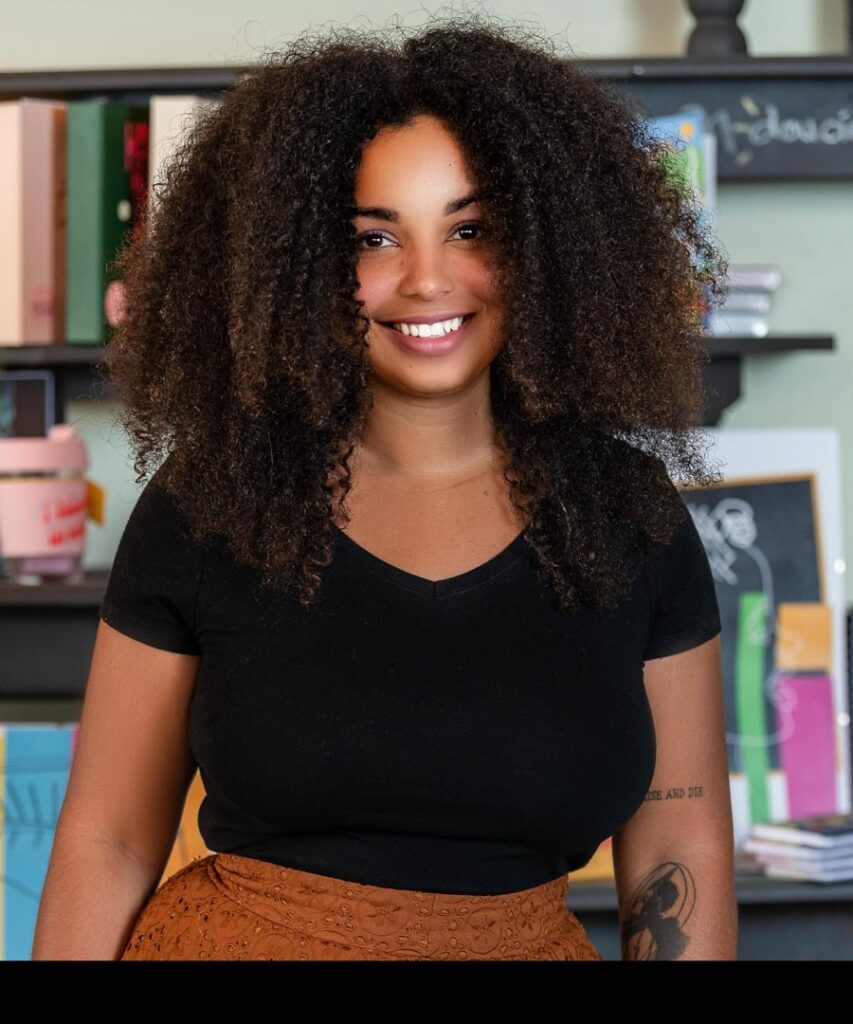
The researcher
Kimberley Demagny
Independent researcher in art and technology in the Global South, specialising in contemporary Caribbean creation.
She is interested in what happens when technology meets culture, identity and local knowledge, and in how Global South communities can shape these transformations rather than simply adapt to them.
Founder of Caribeart and of arTech Education, a Caribbean training centre at the crossroads of art and technology, she has worked for more than ten years at the intersection of culture, technology and innovation.
She regularly speaks internationally: MTL Connect (Canada), the Dakar Biennale, UNESCO Caribbean, Women in Tech in the Caribbean, and the RAN (Réseaux des Atlantiques Noirs) symposium. She has also taken part in FrancoTech (Paris), Creative Lab (New York), Caribbean Innovation Days (Guadeloupe) and the MAC Conference (Panama).